|
The following Obituary appeared in the Glasgow Herald:
Born: January 22, 1942; Died: November 29, 2014
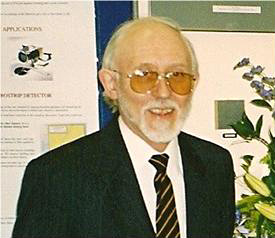
James Edmond (Eddie) Bateman, who has died aged 72, was a world expert on medical imaging who spent more than 30 years at the Rutherford Appleton research laboratory in Oxfordshire. His ground-breaking work included researching and developing much of the medical imaging equipment being used today.
Born in January 1942 in Stirling and brought up in Alva, seven miles east of Stirling, he attended Alva Academy and qualified to enter Glasgow University in either the arts or science. It is said that he chose science because it was more of a challenge.
Graduating in natural philosophy (physics) in 1963 from Glasgow University he then gained his PhD and became a post-doctoral research worker at Durham University.
In 1972, he joined the Rutherford Appleton Laboratory (RAL) where he was to remain for the rest of his working life. His arrival at RAL coincided with the beginnings of the Multiwire Proportional Counter and thus gas avalanche counters came to dominate his life.
In addition to supporting the High Energy Physics program through the 1970s and 1980s, he was responsible for diversifying this technology into other areas of application, chiefly bio-medicine. Bone densitometry, auto-radiography and positron emission tomography were key areas.
In the 1990s, he developed micro-pattern gas devices which produced imaging x-ray detectors for the Synchrotron Radiation Source at Daresbury Laboratory, the DIAMOND light source and the ISIS neutron source at Rutherford Appleton Laboratory. There will be many medical professionals and patients who owe much to the skills of him and his colleagues.
Glaswegian friend and fellow physicist Bill Toner said: "Eddie kept on working from home throughout many years of ill health. His range of knowledge was amazingly broad. Only recently he became interested in the high power laser fusion experiments at RAL, where the ultra-short laser pulses created conditions like a lightning-storm in the target chamber and blew fuses in detection equipment, making analysis impossible.
"As recently as late 2012 he sent me a draft paper he had written outlining a simple way to very much reduce the problem, which we discussed on the phone. Typical of Eddie, he had gone right back to first principles, quoting his notes from a course on special relativity he had attended in 1962 and showing there was no need for giant computer codes."
In 2003, he was awarded the MBE for services to medical imaging and, so that his many friends, colleagues and collaborators could share in the award, he chose to have it presented locally by the then Lord Lieutenant of Oxfordshire, Sir Hugo Brunner.
Another friend, Fred Wickens, said in a tribute said that he was "a proud Scot, with strong views, which he would eloquently defend, although sometimes with rather florid language. Passionate about his work. Generous, but careful with money. A good sense of humour and a twinkle in his eye. A kind neighbour, a valued colleague, but most of all a good friend."
He and his wife Carol lived in Abingdon from 1972 to 1976 and were both involved in raising funds to build the Preston Road Community Centre. They moved to Appleton in 1976.
Eddie Bateman and Carol Littlefield were married in June 1967 in Glasgow. They shared a love of music having met through the Glasgow University Chapel Choir in 1965. His love of music was quite broad and latterly he became fond of ABBA.
He is survived by Carol. A Celebration for Eddie's Life was held in a packed St Laurence Church Appleton on 12th December 2014 and the service was conducted by Rev Lyn Sapwell and was concluded by a rendering of Thank you for the Music by ABBA.
|